CNY Antique Tractor Club Logo

ARTICLES

 
Who Makes What?
June 2011
 

Summer is here and the show season is in full swing. If you are like most collectors of old iron finding the next project is always on your mind and what better place to find that diamond in the rough than at a show. Spectators may approach with the piece in the back of their shed that the have decided has to go or an exhibitor has the answer to your dreams for sale at a price that begs you to take it home. Many times brand name doesn't matter, it's the uniqueness of the item.

Who makes what or who owns the brand can be confusing in both the large equipment and for those collecting lawn and garden type equipment. When companies only sold their one brand and did not private label it was simple to figure out who made what.

Older lawn and garden equipment had become quite collectable due to the relative low cost and ease of movement as compared to full size farm equipment. Another factor is that younger collectors look for equipment they have a connection to from their youth and many have no farm back round.

The web site MyTractorForum.com has a listing compiled by one of their members as to who owns, builds or built and brands connected with lawn and garden tractor manufacturers. The book GARDEN TRACTORS by Oscar H. Will III details the history of some of the more common brands from the 1930's till 2009.

Many brands were not all built by the same manufacturer changing from year to year and in some cases different models in the same year came from different sources.

One company profiled in Mr. Will's book is Modern Tool and Die more commonly known as MTD. The company started in 1932 and expanded to make automotive products such as fenders and radiator cores. Lawn and garden equipment was added in the 1950's. The first gasoline powered mowers were built in 1958 and sold as private label machines to Western Auto, Firestone, Montgomery Wards and others. The first riding mower was produced in 1959, a 4 horsepower single blade mower direct coupled to the engine and could not be shut off. The company continued, producing it's first snow blower in 1968. In 1975 MTD purchased the Yardman Company, but the main thrust was producing private label goods customized to the wants of the buyer. In April of 1981 MTD became the owner of Cub Cadet and also White Outdoor Power Equipment. 2001 brought Bolens and Troy-Built and in 2006 Massey-Ferguson in Europe. Since 2007 MTD has built Lawn and Garden tractors for Toro.

Some brands never had a manufacturing arm but were sold as a Brand not associated with stores. Scotts were made by MTD, Murray, and John Deere.

Massey-Ferguson made by AMF, Snapper, Ingersoll, and Simplicity.

Poulan and Poulan Pro,were made by Electrolux/American Yard Products and since 2007 Husqvarna.

Dynamark (sold at Central Tractor Parts stores) AMF and Murray.

Today the number of manufacturer keeps shrinking due to consolidation in the lawn and garden equipment industry. At one time all most all engines were sourced from outside vendors. Now Briggs and Stratton corporation owns many brands of lawn and garden equipment. Brands tied to the Briggs label are : Simplicity, Allis Chalmers, Deutz- Allis, AGCO-ALLIS, AGCO, Massey Ferguson, Homelite, Montgomery-Wards, Snapper, Ferris, Brute Murray,Victa and Power King.Briggs also has manufacturing partnerships with Craftsman, Husky, John Deere and other companies world wide.

Pennsylvania Panzer
At least 4 members of the CNY Antique Tractor Club own tractors made by the Virginia Metalcrafters of Waynesboro Va. The original Pennsylvania Panzer was built in 1954 and was the size of a small compact utility tractor of today with a tricycle front end. The original name was COPAR PANZER and the horsepower was furnished by a B&S 9 hp motor. A smaller lawn tractor was introduced in 1958 with a 4 hp Clinton or 5 3/4 B&S motor. The original tractors were painted red/yellow.

COPAR was sold to Virginia Metalcrafters in1960. The smaller tractors were redesigned and the larger ones dropped. The new paint was Turquoise. From ‘61 to’63 the grills read Panzer. In 1963 The Pennsylvania Lawnmower Co. was purchased and the name was again changed in 1964 to Pennsylvania Panzer. The design remained the same until 1966 when a major redesign changed the rounded hoods to square and the belt tightener drive was changed to the first hydrostatic transmission used on a small garden tractor. The name was also changed to Pennsylvania Meteor. The Meteor was dropped in 1958 as to expensive and the tractor production ceased in 1070.

 
Reinventing a Way of Life
October 2010
 

Reinventing has been a way of life for most successful farm machinery manufacturers. In most cases the changes were not made to gain market share but to ensure the survival of the company. It took courage to make the radical changes that many looked on as foolish, and good marketing campaigns’ to introduce the changes to the farmers of the day. As we all know farmers have gone from horses to some of the most sophisticated equipment known to man in a mere 100 years. During that time many companies were born but few survive today. Let’s look at some of the reinventions that some of the companies took.

The most notable reinvention took place August 30, 1960 in Dallas, Texas. John Deere announced to the world their new 4 and 6 cylinder powered tractors. This was a gamble that no one could have predicted the outcome and it turned into a huge success for John Deere with more than 400,000 new tractors sold in the next decade (1). Because this reinvention happened during most of our lifetimes, it is the one most of us know about, but it is not the only one. In the days of the agricultural steam traction engines there were many companies that did not survive the transition to smaller, lighter machines and faded into the sunset as the age of steam ended.

One survivor was J.I. Case and Company. Even though the demand for steam traction engines was still strong , Case developed a tractor and started production in 1912. This reinvention moved Case into the internal combustion age. The engine on the earliest tractors was mounted cross ways. This design served Case well, but the changing industry necessitated the change to inline engines in 1929 (2).

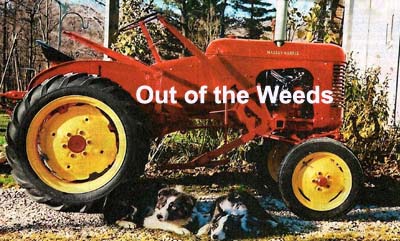
Some companies tried to reinvent them selves and failed. The Massey-Harris 4 wheel drive is an example. The tractor was manufactured from 1930 to 1938 in Massey’s first attempt at manufacturing a tractor to fit the row crop market. As a 4-wheel drive the tractor was 50 years to early. Massey-Harris also reinvented it self in 1938 when the new tractors introduced that year had an engine on frame design rather than the oil pan of the engine being part of the frame. The unibody design came to Massey with the purchase of the Wallis company in 1928. Massey -Harris  continued until 1953 when it acquired the Ferguson Company. The original intent was to maintain two separate equipment lines. This proved unworkable and in 1957 the reinvented Massey Ferguson tractors were introduced. Diesel engines were supplied by F. Perkins Company Ltd., which had been recently acquired. These two changes led to Massey Ferguson becoming one of the worlds largest tractor manufacturers (3).

Henry Ford introduced the 2n in 1939 to the American market. This replaced the Model N and earlier model F which were similar. With the addition of the Ferguson System of 3-point hitch with draft control the smaller 9n was the reinvention that Ford needed to increase market share. Over  272,000 9n and 2n were built from 1939 to 1946.

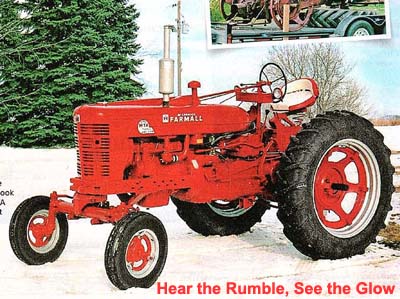
The International Harvester company was formed in 1902.It is unique that no steam traction engine was ever marketed by International Harvester The earliest tractors from International Harvester were large and heavy .Attempts in the teens and twenties to develop a small all around tractor led to the 10-20 and 15-30,but these were the same design as everyone else of the day. The reinvention of the tractor came with the introduction of the Farmall Regular in 1924.This tractor with a tricycle stance allowed for row crop farming with a tractor for the first time. This was the first row-crop tractor tested in Nebraska (4). International Harvester and J.I. Case merged in 1984 to form Case International and reinvent itself once more.

Oliver Corporation reinvented it self when it unveiled the Oliver Hart-Parr model 70 Row Crop in 1935. This was the first Oliver tractor to use a 6 cylinder high compression. Also side panels were added to enclose the engine when most other manufacturers had discontinued them. The enclosed engine design would identify most Oliver models until the introduction of the Super Series in 1954.

The next reinvention involving Oliver was the purchase of Oliver by White Motors along with Minneapolis Moline and Cockshutt. The result was the White Tractor introduced in 1974. The late 1970’s would see White Motor Company in bankruptcy selling the White Farm Equipment Division to an investment firm in Texas The next new owner in the reinventing of White was Allied Products of Chicago, also the owner of New Idea.

The Allis Chalmers company was taken over by Deutz of Germany in May of 1985. The new company known as Deutz-Allis would be a subsidiary  of Klocker-Humboldt-Deutz. The hope was that this merger would lead to a greater presence in the U.S. for Deutz. A true reinvention that failed was the change from orange to green. Farmers in the U.S. wanted orange paint. The air cooled engines from Deutz were not popular with American farmers. When AGCO was formed in 1990 and purchased the assets of Duetz-Allis the Allis orange paint returned to North America along with more familiar liquid cooled engines.

The last reinvention to discuss is the announcement that the Allis Orange will go away yet again. Agco has announced the consolidation of brands in North America to just two tractor brands. The two will be Massey Ferguson and Challanger. For natives of central New York this may seem a bit odd. Neither of the two brands have ever held a strong presence in this area. Some may even question what the Challenger brand is. Challenger is a brand from Caterpillar given to large tractors and a combine they marketed. One more attempt to reinvent the farm equipment industry.

(1) The American Farm Tractor by Randy Leffingwell, copyright 1991
(2) ibid
(3) The Proud Heritage of Agco Tractors by Norm Swinford, copyright 1999
(4) Standard Catalog of Farm Tractors C.H. Wendel, copyright 2005